

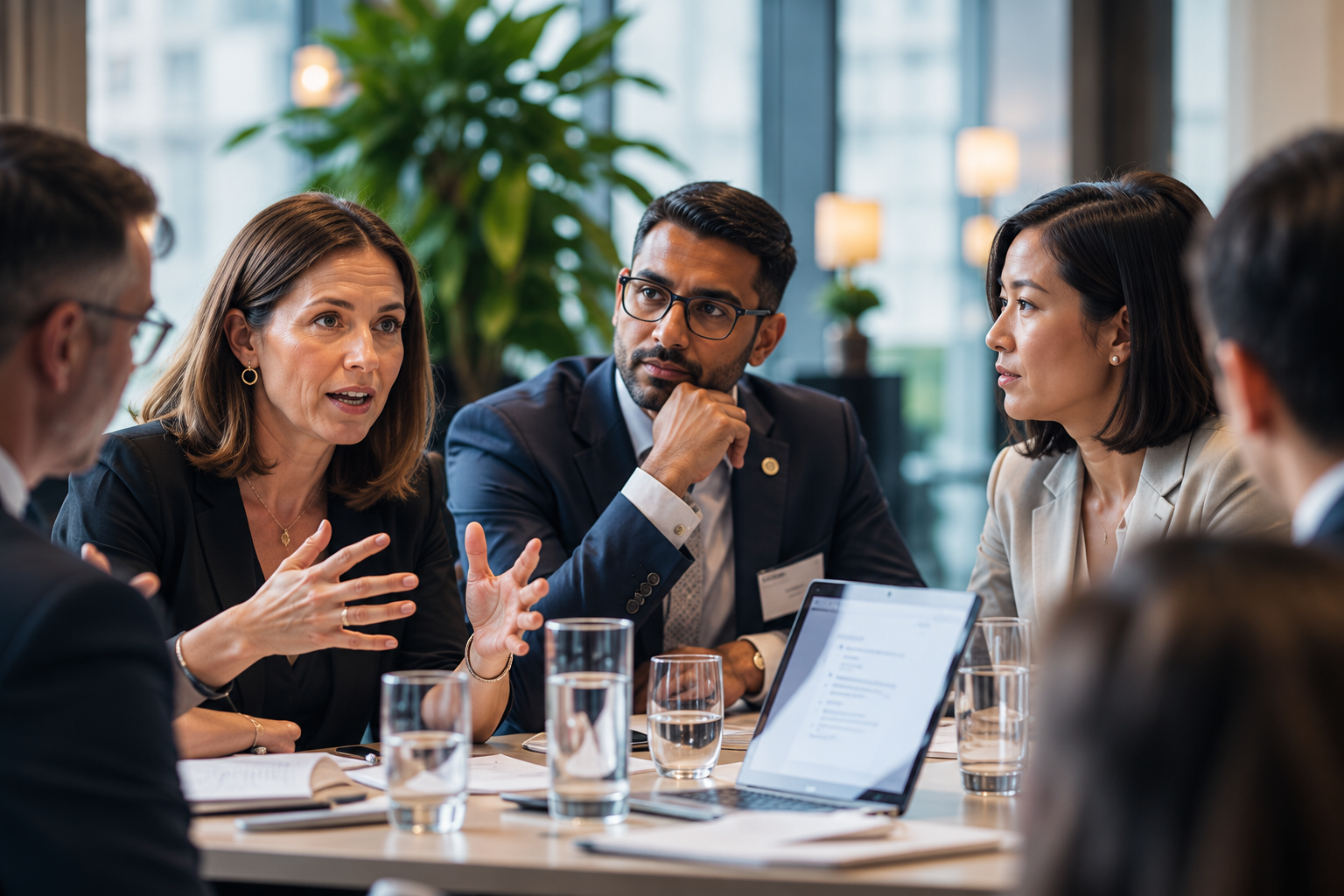
Many asset-management firms already have Employee Resource Groups (ERGs), inclusion programmes and colleagues working to build more inclusive cultures. Culture Builders was created to connect people facing similar questions across firms, so shared experience can lead to practical progress.
Why a cross-company community was needed
During the webinar, Lisanne Molina, Head of Learning, Culture, Diversity and Inclusion at Aegon Asset Management and Lead of the IiFE Inclusive Culture Community, explained that initial IiFE/PwC research on Embracing Inclusion in European Asset Management had identified inclusive culture as an area with room for improvement.
She described culture as something shaped both by leadership and by employees working at grassroots level:
“Culture doesn’t only happen bottom up or top down. It’s really a combination of the two.”
Lisanne Molina · Lead, IiFE Inclusive Culture Community
This led the IiFE Inclusive Culture Community to develop two initiatives. One focused on helping leaders foster inclusive cultures. The other focused on helping the people championing culture within firms become more effective.
Culture Builders was the second of these initiatives. Molina described its purpose as creating a shared space where colleagues from Inclusion in Finance Europe (IiFE) member firms could connect, exchange ideas, strengthen collaboration and co-create practical resources.
Its role is therefore not to duplicate firms’ internal programmes. It is to help the people doing this work compare experience across organisational boundaries.

What the first session revealed
The first Culture Builders session was held on 23 April 2026. It combined expert input, live questions and small-group discussions.

Aniela Unguresan, founder of EDGE, used four live questions to test assumptions about inclusion, career development and organisational practice. Two findings were particularly relevant to the role ERGs can play.
Opportunity matters as much as communication
When participants were asked to identify the strongest enabler of inclusion in the workplace, open and honest communication received the most votes.
Unguresan then said that research conducted with Bain and Company had identified growth opportunities and transparent feedback as the leading enabler, followed closely by open and honest communication. Bain and Company was cited during the webinar; the underlying research has not been independently checked for this article.
The distinction matters. Communication may help people feel heard, but an employee’s experience of inclusion is also shaped by access to feedback and opportunities to develop. For an asset manager, those choices affect who builds experience, whose judgement develops and who becomes ready to assume greater responsibility.
Careers progress through the work people are trusted to do
A later question asked participants to choose the most important career accelerator from leadership development training, networking opportunities and stretch assignments. The answer presented during the webinar was stretch assignments.
Unguresan argued that employees from historically overrepresented groups have often found their way into these assignments more easily. Her point was that firms need to create more intentional routes into career-building work for other high-potential employees.
Training and networking have a role, but access to demanding work can influence how employees develop and how others assess their potential.
Ric van Weelden, Chair of Inclusion in Finance Europe, connected this argument directly to the industry:
“Better composed, better led teams make better decisions. And in our industry, decisions are ultimately the product.”
Ric van Weelden · Chair, Inclusion in Finance Europe
ERGs cannot create change in isolation
Unguresan described ERGs as developing from event-oriented activity towards talent development and closer partnership with the business and human resources teams.
That progression does not mean turning every ERG into a corporate programme. It means connecting the trust and employee perspective within the group to the people who control organisational processes, resources and decisions.
During the webinar, Unguresan described this as a “community of practice” involving ERGs, business leaders, human resources professionals and talent managers. She argued that ERGs cannot operate to their full capacity in isolation.
The breakout-room debrief reinforced that point. Participants described organisations at different stages of ERG development. Some had structured, issue-specific groups, while others had broader or emerging networks.
They also raised differences in organisational culture, whether ERG activity took place during working hours, the difficulty of securing leadership support and, in some cases, the challenge of finding an executive sponsor. Other participants highlighted what was working: visible ERGs, a strong connection with organisational culture and access to high-quality training.
The lesson was not that every firm should adopt the same model. It was that practitioners can learn from different approaches while recognising that each organisation begins from a different position.
Recognition must become practice
The session identified several conditions that can help ERGs increase their contribution.
Their objectives should connect with the organisation’s business strategy. Executive sponsorship should be active rather than symbolic. Leadership of the ERG should be sustainable and shared, rather than dependent on one individual. The organisation should also consider how ERG contributions are recognised in performance reviews.
This last point matters because some employees undertake ERG activity alongside their existing responsibilities or outside normal working hours. If firms consider the work valuable, they need to decide how time, recognition and organisational support will follow.
Culture Builders cannot make these decisions for individual firms. Its value lies in connecting people who are working through the same questions, so they can exchange experience, test ideas and take more informed action within their organisations.
That is the practical case for the initiative: not another layer of inclusion messaging, but a place where knowledge can travel between firms and become more useful.


