


In this article
The first Inclusion in Finance Global Annual Event, held in London on 12 June 2026 and hosted by DWS, brought Inclusion in Finance Europe (IiFE), Inclusion in Finance UK and Nicsa’s Inclusion in Finance North America together as one global community. Their shared ambitions address the wider financial services industry; IiFE focuses on European asset management. The collaboration creates opportunities to share research, programmes and experience while responding to different markets and working cultures.
Drawing on discussions during the global event, this article explores three connected themes for European asset managers: understanding the people they serve; developing talent and improving decisions within their firms; turning shared experience into locally relevant action.

“The industry has to reflect the people that it serves,”
Ric van Weelden · Chair, Inclusion in Finance Europe
For Ric, shifts in whom the industry serves and employs create a defining opportunity for Inclusion in Finance Europe. Inclusion is no longer separate from business strategy. It is becoming part of how European asset managers understand their clients, design products and build teams.
Understanding whom the industry serves
Raymond Sagayam, Managing Partner at Pictet Group, Co-CEO of Pictet Asset Management and a member of IiFE’s Advisory Council, introduced Maria, a fictional character whose circumstances illustrate the pension challenge: a 71-year-old woman living in Naples on a state pension of €820 a month. Her late husband, Mark, received €1,500 a month, and she has outlived him by 12 years.
“Maria isn’t the exception. She is the system working exactly as it was designed.”
Raymond Sagayam · Co-CEO, Pictet Asset Management
Her circumstances illustrate the retirement needs Raymond wanted the industry to confront. His wider argument concerned pension design that assumes a forty-year career, despite time spent raising children, caring for older relatives and funding a longer life. As responsibility shifts from institutions towards individuals through defined contribution arrangements, the assumptions behind retirement products become more consequential for savers.
The disparity is substantial. Eurostat reports that women aged 65 and over in the EU received pensions averaging 24.5% less than men’s in 2024. Raymond’s challenge sits against that wider gap.
Asset managers cannot determine Maria’s state pension. They can examine whether their own retirement propositions assume uninterrupted contributions across forty years and whether that pattern fits the clients they serve. Their communications deserve the same scrutiny: what picture of a working life do they present, and can savers with a different contribution history see where they fit?
The business case sits alongside the concern about retirement outcomes. McKinsey’s 2022 research, Wake up and see the women, projected that women investors would control €10 trillion of Western European assets under management by 2030. Its definition includes partnered women identified as their household’s financial decision maker. This describes the wider investment market; it does not measure women’s pension savings. Raymond’s argument was that firms risk overlooking a growing client market when they fail to understand the people they should serve.
“Europe built a pension system for Mark, but the reality is half of the continent is called Maria.”
Raymond Sagayam · Co-CEO, Pictet Asset Management
The audience selected his proposal as the winner of the event’s Dragons’ Den session, choosing between pension inclusion, engaging colleagues in inclusion work and inclusive AI adoption.
Pension evidence
Raymond’s challenge to asset managers
- Raymond made the challenge concrete: audit every product launched over the next twelve months and ask whether it closes or widens the gender pension gap.
- If firms do not know, he urged them to find out.
- His call to design and plan for a thirty-year career rather than an uninterrupted forty-year one brings the product assumption into focus; his appeal to discuss the issue with boards, clients and families makes it a question for business strategy as well as product teams.
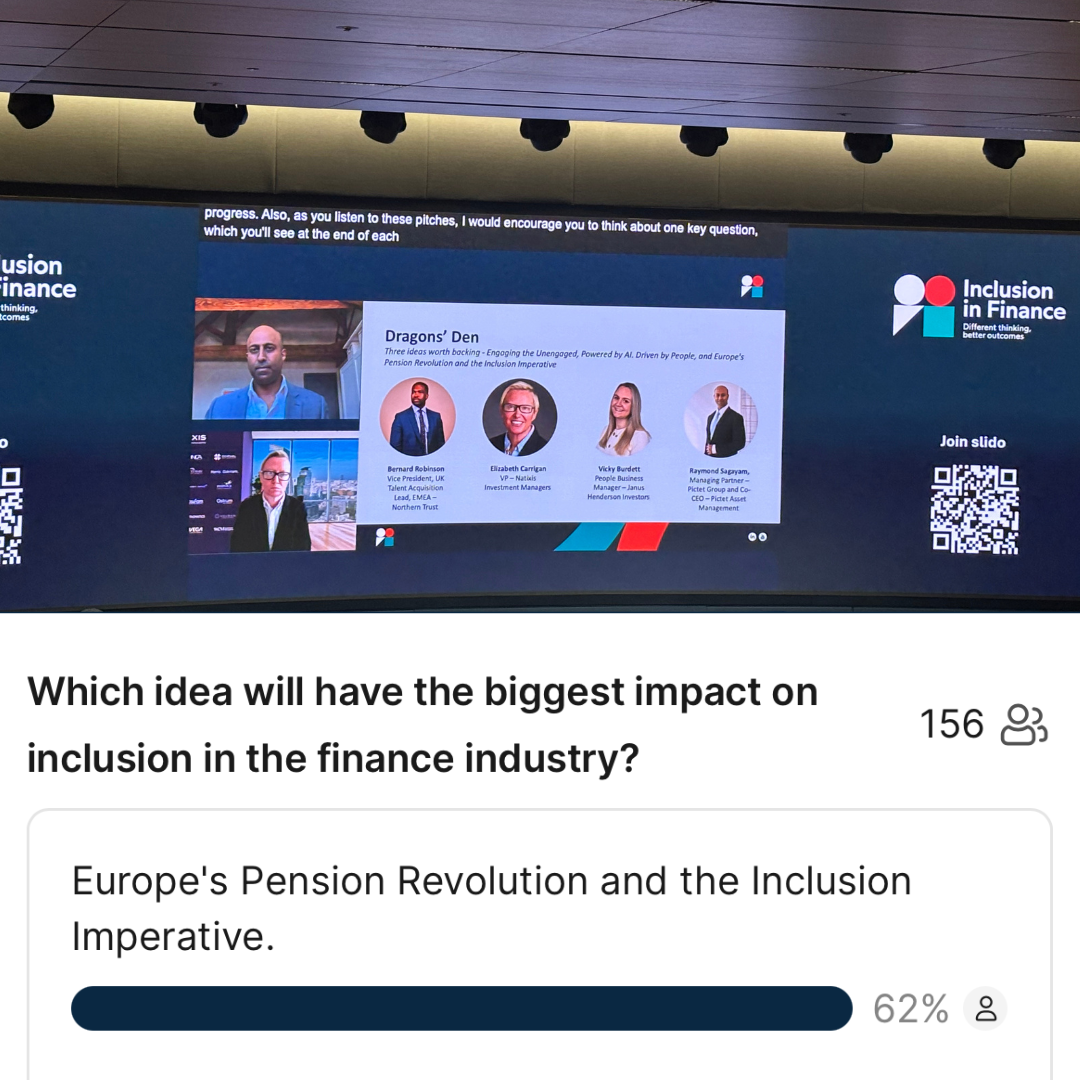
Raymond brought the issue inside the workplace:
“The people most exposed to the pension gap are often the ones sitting next to you in the open plan office.”
Raymond Sagayam · Co-CEO, Pictet Asset Management
That observation connects clients’ working lives with those of colleagues: both are shaped by careers that rarely follow an uninterrupted path.
Developing talent and improving decisions
Rise Across is one way the industry is supporting those careers within its own workforce. Asmus Tvede Madsen, Strategic People Expert at Nordea Asset Management, IiFE board member and Gender Equality Community Lead, described the programme’s pilot phase, connecting women with experienced professionals across companies, countries and functions to build networks, gain new perspectives and accelerate their development.
It reaches women at different career stages: 41% of mentees have more than seven years’ industry experience. That extends its support beyond entry into the industry to women with established careers. Asmus stressed that the programme is not reserved for a small group of future leaders: it supports women starting out and experienced professionals considering their next step.
The figures describe participation, with findings from the pilot phase expected to be published in November 2026.

Rise Across in numbers
Rise Across creates opportunities to learn from people beyond an individual’s usual professional circle. The question for firms is how to carry that openness into everyday work: once people bring different experiences and perspectives to a team, how do leaders ensure those differences inform its decisions?
Different perspectives, better decisions
The Cognitive Diversity Member Panel explored that question through Inclusion in Finance’s Cognitive Diversity research. Commissioned from Professor Alex Edmans of London Business School, the research examined how different thinking styles affect investment performance.
Mitesh Sheth, founder of Org Alpha and a board director of Inclusion in Finance UK, described how sharing the research with member firms revealed practical gaps: teams needed help measuring cognitive diversity and leaders needed support to use it effectively. Three tools followed, combining material firms could use internally, team assessment and leadership training:
turns cognitive diversity research into accessible material firms can present and discuss internally.
Adapted from Lloyd Mander’s DOT Scorecard, it uses a ten-minute team questionnaire to assess differences in thinking and the cultural conditions for using them, with group reporting and recommendations.
is a ninety-minute session delivered by executives for executives, examining how meetings, problem diagnosis, risk identification and other parts of decision-making can include different perspectives.
The panel then showed how firms had used them.
Emma Potter, Community Engagement and Belonging Director at AllianceBernstein, said the Inclusive Leadership Masterclass created a safe space in which leaders opened up about how they interpreted and responded to colleagues. The discussion helped participants understand what enables different people to contribute and prompted them to examine how decisions are made, who participates and whose perspective adds value.
Andrzej Pioch, Head of Risk Targeted Funds at L&G Asset Management, explained how the DOT Scorecard helped the asset allocation team identify contrasting thinking styles. When facing a complex decision, the team can now deliberately seek a different perspective rather than defaulting to someone likely to agree.
These examples bring cognitive diversity into everyday decisions. Who contributes? Whose perspective is missing? When a complex decision arises, does the team deliberately seek challenge or default to agreement? Cognitive diversity creates potential, but leaders must create the conditions in which different perspectives can shape decisions.
Making a global community useful locally
The cognitive diversity discussion showed why firms benefit from perspectives beyond those they habitually hear. The global community applies the same principle across markets: each organisation can draw on the others’ experience while deciding what is relevant to its own members. Talent development made that exchange tangible at the event.
Inclusion in Finance UK highlighted Pathway, a twelve-month programme for high-performing women interested in or working in front-office roles, combining technical learning, live simulations, a model portfolio project and firm sponsorship. Nicsa’s Inclusion in Finance North America presented Rising Stars, which develops emerging leaders through self-awareness, communication, coaching and peer relationships across the industry. IiFE’s Rise Across connects women with experienced mentors across firms, countries and functions.
The programmes address different career stages and development needs. For firms, they offer practical ways to build broader, more resilient talent pipelines. The global community adds value by enabling each organisation to learn from approaches developed in other markets without assuming that one model will work everywhere. For IiFE and its members, that means applying what fits the regulatory context, working cultures and client needs of European asset management.
Highlighted in this article
Many programmes were shared at the global event, and each organisation runs a wider range of research, programmes and member activity. This article focuses on a selection.
Pathway, a leadership and development programme for women in front-office roles
Explore their work →Rise Across, pan-European cross-company mentoring for women
Explore their work →Rising Stars, a leadership development programme
Explore their work →Who is the industry being built for?
It should be built for the people it serves and employs, including those whose careers, retirement needs and ways of thinking differ from familiar assumptions. Maria’s pension and a colleague’s next career step point to the same question: which working life did the industry assume? Answering it means examining products, widening access to development and making room for different perspectives in decisions. The global community becomes useful when shared experience helps firms do that in their own markets.


